
Front-running is a fraudulent practice where traders exploit advance knowledge of large client orders for personal profit.

'Investors with foreign currency-denominated goals, such as foreign education or foreign travel, should go for US equity funds.'

'Investors may have made money in mid and smallcaps due to market momentum, but now they need to focus on fundamentals.'

Younger investors with long investment horizons may continue their SIPs.

After a strong run in the midcap and smallcap indices, which surged 46 per cent and 43 per cent, respectively, on the National Stock Exchange (NSE) during Samvat 2080, analysts suggest that the rally in these segments may pause to catch its breath in Samvat 2081.


Report says SEZs had resulted in a revenue loss of Rs. 1,971.39 crore.

Dollar selling by exporters and banks amid a higher opening in the domestic equity market also supported the rupee, dealers said.

2000 India-South Africa series: Court says some matches fixed, attempts made to fix others

The local currency lost some of the gains after the forex market realised that RBI's decision would result in only up to $3 billion extra dollar supply in the market in initial stages.
The hotel industry seeks infrastructure status and tax breaks, considering the huge investments required to meet the growing demand, especially in the NCR region for upcoming Common Wealth Games.

'As we navigate uncertain waters, a conservative approach to largecap investing could provide a strategic advantage.'

Larger listed domestic-focused tyre companies have underperformed the benchmarks in the last three months but exporter Balkrishna Industries has bucked the trend. The company, which exports off-highway tyres, has generated 43 per cent returns in this time compared to MRF and Apollo Tyres, which are down 5-10 per cent. In addition to better-than-expected performance in the March quarter, exports and market share gains have helped Balkrishna pull ahead of peers.

Gautam Adani, India's second-richest man, and seven others including his nephew Sagar have been charged with paying bribes to unidentified officials of state governments in Andhra Pradesh and Odisha to buy expensive solar power, potentially earning more than $2 billion profit over 20 years.
Nestle, Titan, ICICI Bank, Tata Steel, IndusInd Bank, ITC, JSW Steel and State Bank of India were the other laggards. Among the gainers, Tata Motors jumped nearly 6 per cent. Larsen & Toubro, Sun Pharma, Kotak Mahindra Bank, Bajaj Finance and Power Grid also ended in the positive territory.

New investors should gradually build a 5 to 10 per cent allocation to gold.
While SGBs are a sound investment, they aren't worth buying at any price. The interest income you earn from them will not justify paying a high premium.
The Indian Textile Industry is currently one of the largest and most important industries in the Indian economy in terms of output, foreign exchange earnings and employment.
Foreign tourist arrivals to India rose 12.4 per cent in the first three months of 2003 from the same period a year earlier, government data showed on Thursday.\n\n\n\n
There had been no significant impact of the United States-led war against Iraq on India's foreign exchange earnings or on its exports and imports, Finance Minister Jaswant Singh said in the Lok Sabha on Friday.
Indian hoteliers and consulting organisations fear that worst is yet to come, as many international companies ranging from large corporate houses to medium-sized firms look to cut back on travel.

Foreign investors continued their relentless selling in the Indian equity markets in August, offloading shares worth Rs 21,201 crore due to the unwinding of the yen carry trade, recession fears in the US and ongoing geopolitical conflicts. This came after an inflow of Rs 32,365 crore in July and Rs 26,565 crore in June, data with the depositories showed.
M&M was the biggest gainer on the Sensex chart, rising 5.97 per cent, followed by JSW Steel, Ultra Cement, Kotak Bank, ITC and NTPC. Reliance Industries gained 0.73 per cent to close at Rs 2,871 apiece. In contrast, TCS, HCL Tech, HUL, Nestle Industries, Bajaj Finserv, Wipro and Infosys were among the losers.
An estimated 35,37,630 foreign tourists visited India in the year 2004-05 as compared to 28,78,638 during 2003-04, showing an increase of 22.9 per cent, the Rajya Sabha was informed on Tuesday.

Equity benchmark BSE Sensex tumbled nearly 700 points to sink below the 79,000 level on Tuesday, extending its losses for the second straight day due to selling pressure in HDFC Bank, SBI and ITC amid fresh foreign capital outflows. The 30-share BSE Sensex tumbled 692.89 points or 0.87 per cent to settle at 78,956.03. During the day, it tanked 759.54 points or 0.95 per cent to 78,889.38.
National Aluminium Company Ltd has won the Engineering Export Promotion Council's All India Export award in the "star performer" category for 2005-06, the firm said on Friday.
India's current account deficit narrowed to $1.3 billion or 0.2 per cent of GDP in the January-March quarter of FY23, mainly due to moderation in the trade deficit and a robust increase in services exports, RBI data showed on Tuesday. However, for the 2022-23 fiscal, the current account balance recorded a deficit of 2 per cent of GDP compared to 1.2 per cent in 2021-22. "India's current account deficit (CAD) decreased to $1.3 billion (0.2 per cent of GDP) in Q4:2022-23 from $16.8 billion (2.0 per cent of GDP) in Q3:2022-231, and $13.4 billion (1.6 per cent of GDP) a year ago [Q4:2021-22]," as per the RBI's 'Developments in India's Balance of Payments during the Fourth Quarter (January-March) of 2022-23'.
The export-oriented software industry has reacted in several ways to the negative impact of rupee appreciation on its financial performance, especially in the last (April-June) quarter.
India's share in world tourism receipts is just 0.67 per cent and ranks 51 in the world international arrivals.\n\n

'Despite rising inflows, many NRIs lack awareness about NRO and NRE accounts and mistakenly use family accounts or invest in a relative's name.' 'Many are unaware of tax implications.'

The most visible and immediate impact of COVID-19 is seen in the hotel and tourism sector in all its geographical segments - inbound, outbound and domestic.

Among the Sensex pack, Tata Consultancy Services climbed nearly 7 per cent after the country's largest IT services player reported 8.7 per cent growth for the June quarter net profit at Rs 12,040 crore. Infosys, HCL Technologies, Tech Mahindra, Axis Bank, Reliance Industries, JSW Steel, Bajaj Finance and Larsen & Toubro were the other major gainers. Maruti, Asian Paints, Titan, Kotak Mahindra Bank, Bharti Airtel and ICICI Bank were among the laggards.
Though tourist arrivals to India rose to 4.43 million in 2006, it was only 0.52 per cent of the global pie.

Among Sensex shares, Bajaj Finance, Mahindra & Mahindra, Sun Pharma, Nestle, NTPC, Power Grid, NTPC, UltraTech Cement and Larsen & Toubro were the biggest laggards. The prominent gainers were ITC, Tata Motors, Asian Paints and Titan.
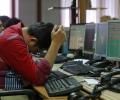
Asian Paints, JSW Steel, ITC, Bajaj Finance, IndusInd Bank, Tata Steel, NTPC, Bajaj Finserv, HDFC Bank, Reliance Industries and Power Grid were among the laggards. In contrast, Tata Motors, Mahindra & Mahindra, State Bank of India, Infosys and HCL Tech were the gainers.

'Over the next 12 months, it will be difficult to make 15 to 20 per cent return in the markets as the valuations appear stretched.'

Industry says though most pending issues have been deliberated upon by Tourism ministry, they are yet to be implemented
 © 2026 Rediff.com - Advertise with us - Disclaimer - Privacy Policy - Sitemap - Feedback - About us - Terms of use - Grievances